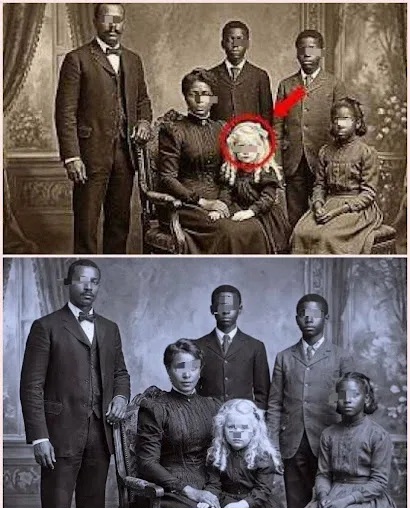
He turned back to the photograph. Clara Washington was posed formally with her family in an expensive studio portrait, dressed beautifully, held lovingly by her mother, and included as an equal with her siblings.
“Her family was protecting her,” Rebecca said.
“Her family was saving her life,” Dr. Mitchell replied, “and documenting it for history.”
With the medical mystery solved, Rebecca needed to understand the world Clara lived in and the specific danger she faced beyond the general brutality of Jim Crow segregation. Dr. Mitchell explained the medical challenges first. Albinism causes severe photosensitivity. Clara’s skin would have burned within minutes of direct sun exposure. In Georgia’s climate, without modern sunscreen or UV-protective clothing, she would have needed to remain indoors most of the time or cover herself completely when outside.
Her vision would also have been significantly impaired. She likely had nystagmus, severe nearsightedness, and extreme light sensitivity. In bright conditions, she might have been functionally blind. There were no treatments available in the 1890s, no corrective lenses that could adequately help, and no low-vision aids.
The social dangers were even more severe. Rebecca found newspaper archives from 1890s Atlanta filled with pseudoscientific racism, eugenics propaganda, and articles treating any physical difference in Black people as evidence of inferiority. The Atlanta Constitution regularly published pieces promoting white supremacy and describing Black Americans in dehumanizing terms.
In that environment, a Black child who appeared white would have been dangerous on multiple levels. White supremacists might have viewed Clara as evidence of racial contamination or degeneracy and targeted her family with violence. Black communities, influenced by African spiritual beliefs carried through slavery, sometimes viewed albinism as supernatural or cursed, which could lead to ostracism or worse.
Rebecca found a chilling article from the Savannah Tribune dated 1893. Under the heading “Tragic Death of Unusual Child,” the brief report described a 6-year-old with a white appearance born to colored parents who died under suspicious circumstances in rural Georgia. The article implied the death was not accidental, but did not elaborate.
This was the reality the Washingtons had to navigate. Yet they had not only kept Clara alive, they had brought her to a public photography studio, posed her prominently in their family portrait, and ordered multiple prints to display.