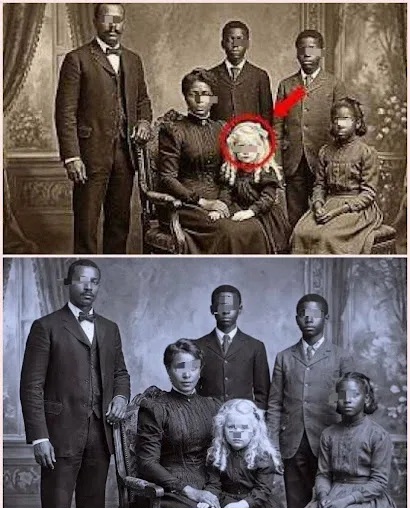
“This isn’t a white child,” he said at once, pointing to Clara’s figure in the photograph. “This is a Black child with complete oculocutaneous albinism.”
Rebecca felt her breath catch. “Albinism?”
“Look at the characteristics,” Dr. Mitchell said, tracing Clara’s features with his finger. “The dramatically reduced pigmentation, not just lighter skin but near-total absence of melanin. The very light hair, probably white, blonde, or platinum. And if we could see her eyes in color, they’d almost certainly be blue or gray, with a visible red reflex from light hitting the retina.”
He pulled up clinical photographs on his computer. Oculocutaneous albinism is a genetic condition affecting melanin production. It occurs in all populations, including people of African descent. In Black individuals, the contrast is especially dramatic, exactly what appeared in the 1897 photograph.
Rebecca stared at the image with new understanding. Clara was not a white child in a Black family. She was their biological daughter with a genetic condition.
“Exactly,” Dr. Mitchell said. “And that makes this photograph historically extraordinary. Do you understand what it meant for a Black family in Georgia in 1897 to have a child with albinism and raise her openly?”
He pulled up research files. People with albinism, especially Black children with albinism in the Jim Crow South, faced horrific discrimination. They were called ghost children, cursed, unnatural. Many communities believed they were supernatural beings or evidence of sin. Families typically hid these children completely, or worse.
“Worse?” Rebecca asked quietly.
“Abandonment, institutionalization, and in some cases infanticide,” Dr. Mitchell said grimly. “There are documented cases of Black children with albinism being killed by their own communities out of superstition and fear.”