The Rose of Jericho, also known as the “resurrection plant,” “dinosaur plant,” “resurrection flower,” or even the “hand of Mary/Fatima,” is a truly remarkable and intriguing plant . There are several different species of plants that bear this popular name, the most commonly referred to being Anastatica hierochuntica (the true Rose of Jericho, native to the Middle East and North Africa) and Selaginella lepidophylla (sometimes called the “false” Rose of Jericho, native to the Chihuahuan Desert in the United States and Mexico) . Although they are different species, they both share the incredible ability to survive in extremely dry conditions.
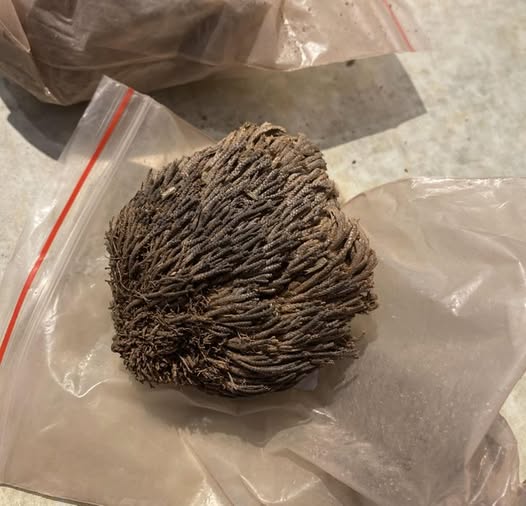
During periods of dormancy or drought, the Rose of Jericho curls its leaves and twigs inward, becoming a dry, gray-brown, seemingly lifeless ball . In this form, it can survive for years, carried by the wind through desert regions .
The miracle of the "resurrection"
The most amazing quality of this plant is its ability to “come back to life” when exposed to moisture . If a completely dried Rose of Jericho is placed in a container of room-temperature water, it undergoes a complete transformation . In just a few hours (usually between 2 and 4), the shrunken ball begins to slowly dissolve, and the leaves and twigs gradually regain their green color, revealing a beautiful, fern-like structure . This process of hibernation and “resurrection” can be repeated many times over the years .