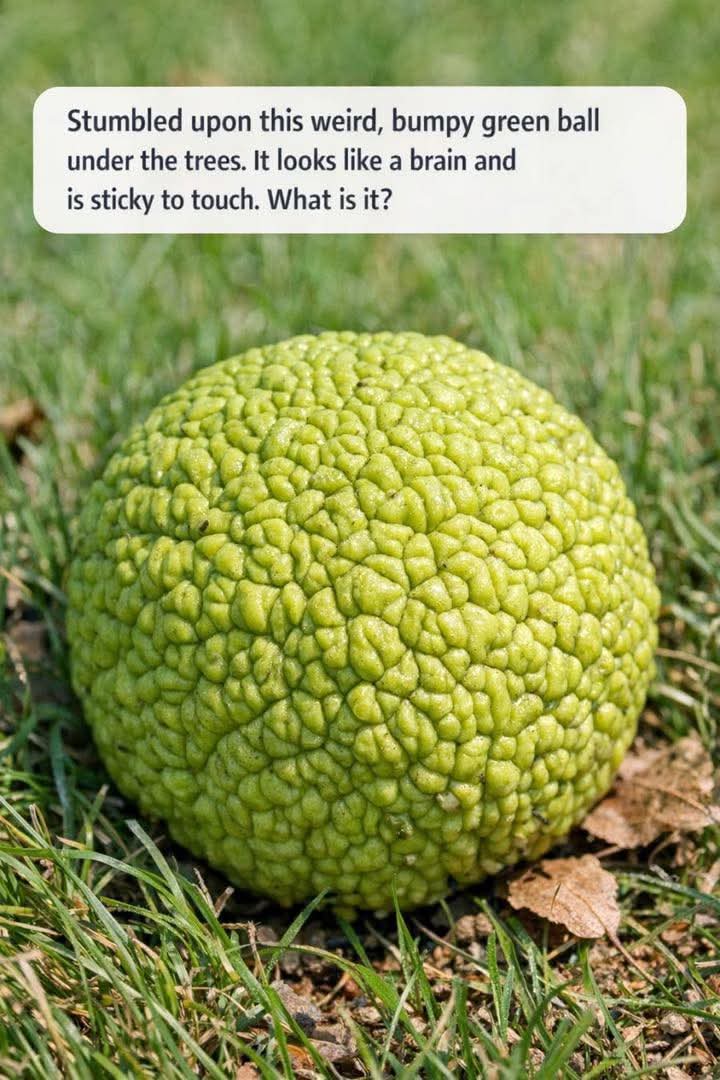
Contrary to its name, the Osage orange is not related to the common orange. Instead, it belongs to the Moraceae family, making it a cousin of the mulberry and fig. The name ‘Osage’ derives from the Osage Nation, a Native American tribe indigenous to the region where the tree naturally grows. The fruit’s green hue and distinctive texture make it an unmistakable sight in the autumnal landscape.
2. How To Identify Osage Orange at a Glance
Identifying an Osage orange is relatively straightforward once you know what to look for. The fruit is large, round, and covered with a network of ridges and grooves, giving it a brain-like appearance. Its color ranges from vivid green to a yellowish hue as it matures.
The tree itself can grow between 8 to 15 meters tall, with a dense, thorny thicket of branches. Its leaves are simple, ovate, and glossy, turning a bright yellow in the fall. The wood of the Osage orange tree is notably dense and strong, often used historically for tool making and other practical purposes.
3. Why Is It So Bumpy, Sticky, and Weirdly Textured?
The Osage orange’s bumpy texture is due to its unique growth pattern. As the fruit develops, the internal tissues expand at different rates, resulting in the characteristic convolutions. This irregular surface is not only visually striking but also serves to protect the seeds contained within the fruit’s core.
Touching an Osage orange reveals a sticky, milky sap that oozes from the fruit. This latex-like substance is a natural defense mechanism against pests and diseases. However, while the sap is harmless to humans, it can be a sticky nuisance if it gets on clothing or skin.
4. Is This Strange Green Ball Safe To Touch or Smell?
While the Osage orange may appear intimidating due to its size and unusual texture, it is generally safe to touch and smell. The sticky sap, although messy, is not toxic. Some people even find the fruit’s faint citrus-like scent pleasant.
However, it’s advisable to wash your hands after handling the fruit, as the sap can cause mild skin irritation in sensitive individuals. As with any wild plant, it’s best to exercise caution and avoid placing the fruit near your face or eyes.
5. Can You Eat Osage Oranges—or Are They Poisonous?